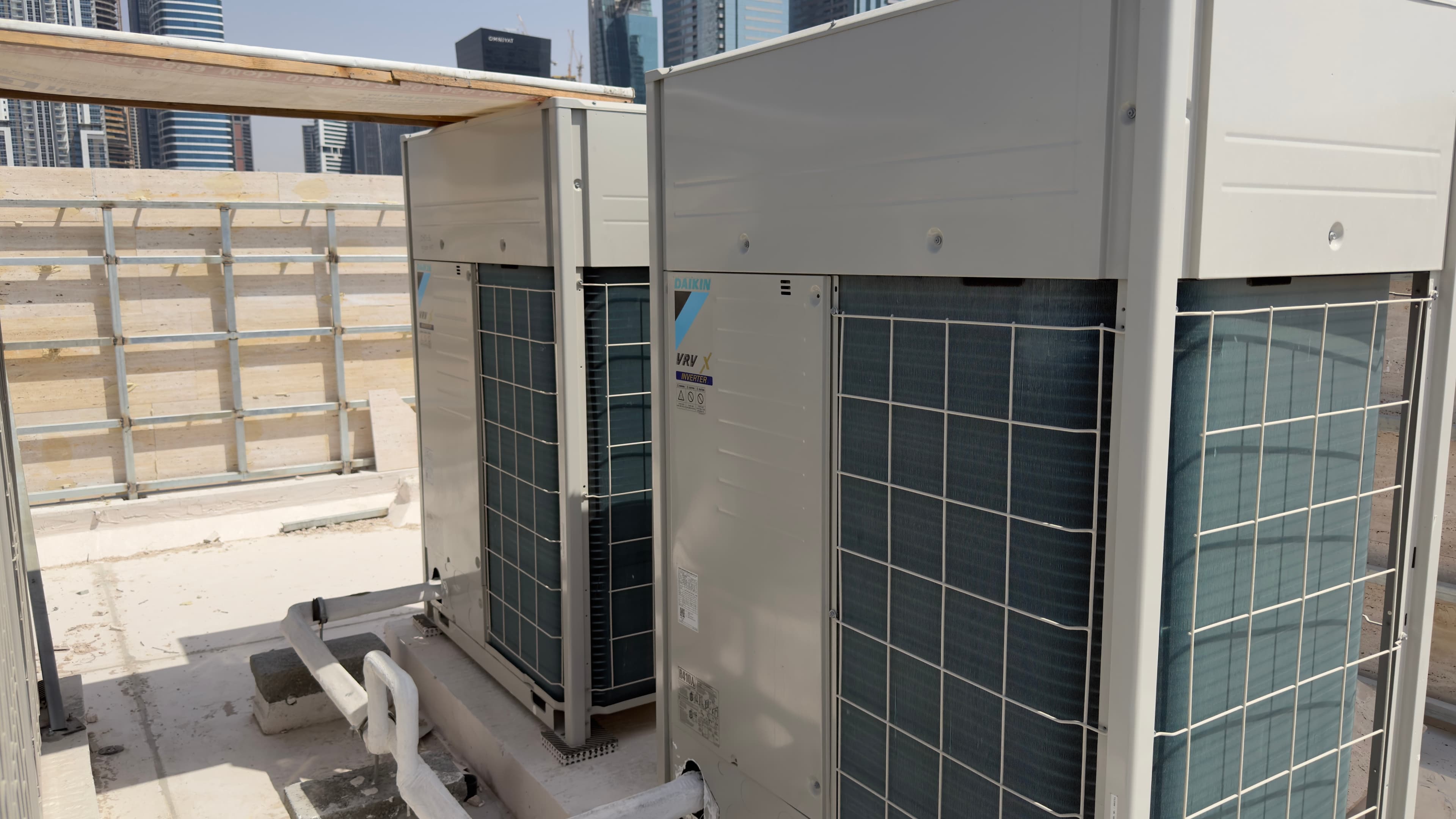
Every villa owner in Dubai eventually faces the same question when planning a new build or major renovation: should we install a VRF system or a chiller plant? Both will keep a villa cool in 45°C summers. Both can be designed to meet Dubai Municipality and DEWA requirements. But they are fundamentally different systems — with very different cost profiles, maintenance demands, and performance characteristics.
We've designed, installed, and commissioned both system types across Dubai, Sharjah, and Abu Dhabi — from compact G+1 villas in Al Barsha to large G+1+R compounds in Emirates Hills and the 18-villa community we delivered in Al Seyouh. This guide is written from that field experience, not from a brochure. By the end, you'll have a clear answer for your villa's size, layout, and budget.
The short answer (skip to the detail below)
- Small to mid-sized villas (under 200 m² built-up area, under ~10 tons of cooling): VRF/VRV almost always wins. Lower install cost, easier maintenance, no plant room needed.
- Mid to large villas (200–400 m², 10–20 tons): VRF/VRV is still usually the right answer, unless the villa has unusual zoning needs or extremely high simultaneous loads.
- Large villas and compounds (400 m²+, 20+ tons, multiple buildings): Chiller plants start making sense — better long-term efficiency, easier to expand, and the cost premium becomes proportionally smaller.
- Multi-villa compounds (3+ villas on a shared plot): Central chiller plant is usually the right engineering decision, even if VRF could technically do the job.
Read on for why.
What is a VRF system?
VRF (Variable Refrigerant Flow), also called VRV (Variable Refrigerant Volume — Daikin's trademark), is a refrigerant-based cooling system. One or more outdoor condensing units sit on the roof or in a yard, connected by insulated copper refrigerant pipework to multiple indoor units throughout the villa.
The system varies the flow of refrigerant to each indoor unit based on demand, allowing different rooms to have different temperatures simultaneously. A modern VRV-X or VRF inverter system can serve 8 to 30+ indoor units from a single outdoor unit array.
Common indoor unit types in villas:
- Wall-mounted (bedrooms)
- Concealed ducted (living areas, where you want hidden air delivery)
- Ceiling cassette (open spaces, kitchens)
- Floor-standing (where wall mounting isn't possible)
In Dubai villas we typically install Daikin VRV-X, Mitsubishi Electric City Multi, or LG Multi V — these are the systems with proven track records in 50°C summer ambient conditions and proper service networks in the UAE.
What is a chiller system?
A chiller cools water (not refrigerant) and pumps that chilled water through insulated pipework to Fan Coil Units (FCUs) or Air Handling Units (AHUs) throughout the villa. The chiller plant typically sits in a dedicated plant room, on the roof, or in an external compound area.
Two main types for villas:
- Air-cooled chillers — most common in UAE residential applications; reject heat directly to outside air
- Water-cooled chillers — more efficient but require a cooling tower; rarely used in single villas, more common in large compounds
A villa chiller plant usually includes the chiller, primary and secondary pumps, expansion tanks, chemical dosing pots, and a Building Management System (BMS) panel for control. This is a more complex installation than VRF — but it's also more flexible at scale.
In Dubai villas we typically work with Trane, York, and Carrier chillers.
Cost comparison: VRF vs Chiller for a Dubai villa
Honest pricing is hard to give because every villa has different requirements. But based on AGEC's actual project records across 30+ installations, here are realistic ranges for complete supply and installation (equipment + piping + electrical + commissioning) as of 2026:
For a typical 250 m² G+1 villa (~12-ton cooling load):
| System | Estimated Installed Cost | Plant Room Required |
|---|---|---|
| VRF/VRV (Daikin/Mitsubishi) | AED 95,000 – 140,000 | No |
| Air-cooled chiller plant | AED 180,000 – 260,000 | Yes (12–18 m²) |
For a larger 500 m² G+1+R villa (~25-ton cooling load):
| System | Estimated Installed Cost | Plant Room Required |
|---|---|---|
| VRF/VRV system | AED 220,000 – 320,000 | No |
| Air-cooled chiller plant | AED 320,000 – 480,000 | Yes (20–30 m²) |
The VRF cost advantage is roughly 30–45% for typical villa sizes — which is why VRF dominates the Dubai villa market for residential builds.
Cost factors that change these numbers significantly:
- Number of zones (each indoor unit / FCU adds cost)
- Distance between outdoor and indoor units (longer pipe runs cost more)
- Quality tier (entry-level vs premium brand selection)
- Ductwork complexity (concealed installations cost more than wall splits)
- Whether smart controls or BMS integration is required
For an accurate figure for your specific villa, request a quote and we'll size the system properly with heat load calculations.
Performance: which one cools better?
Both systems can cool a Dubai villa effectively when properly designed. The differences show up in how they cool and how efficiently they do it over time.
Where VRF wins
1. Individual zone control. Each room can be at its own temperature independently. Your guest room can be off while your master bedroom is at 22°C. Important in villas where rooms get used at different times.
2. Better part-load efficiency. Most villa cooling demand isn't at peak load — it's at 40–70% of design load most of the year. VRF inverters modulate down efficiently. A constant-speed chiller cycling on and off at low load is less efficient.
3. Faster startup. A VRF indoor unit cools a room in 5–10 minutes. A chiller plant has to start the chiller, prime the pumps, and circulate water through long pipework before the FCUs deliver cooling. Cold start times of 20–30 minutes aren't unusual.
4. Quieter indoor side. Modern VRF indoor units run at 25–35 dB. FCUs are similar but the chiller plant outside or in a plant room generates more total noise.
Where Chillers win
1. Long-term efficiency at high loads. Properly designed chiller plants with good controls can achieve better Integrated Part Load Values (IPLV) at consistently high demand — which matters for very large villas, indoor pools, or buildings with high occupancy.
2. Easier to expand. Need to cool a new pool house or guest annex? Adding an FCU to an existing chilled water loop is straightforward. Adding indoor units to an existing VRF system is harder — you may exceed the outdoor unit's capacity and need to replace it.
3. Simpler centralized maintenance. One central chiller is easier to service than 4–6 VRF outdoor units scattered across roofs.
4. Longer equipment lifespan. Quality commercial chillers from Trane, York, or Carrier routinely run for 20–25 years with proper maintenance. VRF outdoor units typically need replacement at 12–15 years.
5. No refrigerant in the building. Chillers contain refrigerant inside the chiller itself; only water circulates through the villa. For very large villas this matters for refrigerant code compliance (ASHRAE 15) and indoor air safety.
Maintenance reality: what most articles don't tell you
The internet is full of glossy "VRF vs chiller" comparisons that ignore the day-to-day reality. Here's what AGEC sees on actual maintenance contracts:
VRF systems:
- Filter cleaning every 3 months per indoor unit
- Coil cleaning annually (more often in dusty Dubai conditions)
- Refrigerant leak checks (refrigerant lines run through the building; leaks are harder to find)
- Outdoor unit cleaning quarterly — Dubai dust kills heat exchanger efficiency fast
- Typical AMC cost for a 250 m² villa: AED 6,000 – 9,000 per year
Chiller systems:
- Chiller tube cleaning annually
- Water chemistry testing every 1–2 months (corrosion and bacterial control)
- Pump bearing checks quarterly
- FCU filter cleaning every 3 months
- Cooling tower service (if water-cooled) — but this rarely applies to villas
- Typical AMC cost for a 250 m² villa with chiller: AED 10,000 – 15,000 per year
Chiller maintenance is more expensive but also more predictable. VRF maintenance is cheaper but the failure modes (refrigerant leaks, compressor issues at one of multiple outdoor units) can be unpredictable.
Real Dubai scenarios
Here's how the decision actually plays out across the kinds of villas we work on:
Scenario 1: 220 m² G+1 villa in Al Barsha
A standard family villa, 8 zones, 12-ton total load, owner-occupied, budget-conscious. VRF is the obvious answer. Lower install cost, no plant room needed, easier ongoing maintenance, and the zone-level control matches how a family actually uses the home — different rooms at different times.
Scenario 2: 480 m² G+1+R villa in Emirates Hills
Higher-end villa, 14 zones, 24-ton load, owner expects long-term reliability, plant room is feasible. Still VRF in most cases, unless the owner wants BMS-grade central control, has plans for future expansion (pool house, gym annex), or wants 25-year equipment lifespan from a Trane chiller. Then chiller is reasonable. The choice is no longer obvious — it depends on the owner's priorities.
Scenario 3: 850 m² compound with main villa + guest house + majlis in Al Khawaneej
Multiple buildings, combined 40+ ton load, complex zoning. Chiller plant. A single chiller serving all three buildings through buried insulated piping is cleaner, easier to expand, and more efficient at this scale than multiple separate VRF systems competing for the same rooftop space.
Scenario 4: 18-villa community development in Sharjah
Multiple identical villas on a shared plot, developer build. Could go either way. Individual VRF per villa gives each owner independent control and billing. Central chiller plant with chilled water distributed to each villa gives the developer lower upfront cost per villa but requires an HOA structure for shared utility billing. AGEC has done it both ways depending on the developer's preference.
So which should you choose?
If we had to give one answer for a typical Dubai villa owner:
For 95% of single-family villas in Dubai under 400 m², a properly designed VRF system from a Tier 1 brand (Daikin, Mitsubishi, LG) will give you the best balance of installed cost, comfort, and long-term value.
Choose a chiller plant if you have a large villa (400 m²+), a multi-building compound, or a long-term ownership horizon where equipment lifespan and central control matter more than upfront savings.
The key word is "properly designed." A poorly sized VRF system will fail in Dubai's summer just as fast as a poorly sized chiller. Heat load calculations, refrigerant pipe sizing, and commissioning matter more than the brand on the box.
How AGEC approaches this for clients
When a client comes to us for a new villa HVAC system, our process is:
- Heat load calculation — room by room, accounting for orientation, glazing, occupancy, and Dubai's actual ambient conditions (we use ASHRAE methodology, not generic rule-of-thumb sizing).
- System comparison — we present 2–3 viable options with installed cost, expected efficiency, maintenance demands, and 10-year total cost of ownership.
- Final design — equipment selection, pipe sizing, duct routing, electrical loads, and BMS integration as needed.
- Installation — by our own engineering team, not subcontracted.
- Testing & Commissioning (TAB) — airflow balanced room by room, performance verified against design, full handover documentation.
- AMC — ongoing maintenance to protect your investment.
If you're planning a villa build or major HVAC replacement and want a real engineering opinion (not a sales pitch), request a quote or call us on +971 55 363 3139. We'll come look at the project, do the calculations properly, and tell you honestly what makes sense.
Related reading
- Our VRF/VRV Systems service →
- Our Chiller Systems service →
- HVAC Design & Consultancy →
- Testing & Commissioning →
Altaher Ghabboun Engineering Contracting (AGEC) is a Dubai-based HVAC contractor specializing in design, installation, testing & commissioning, and maintenance of advanced air conditioning systems across the UAE.