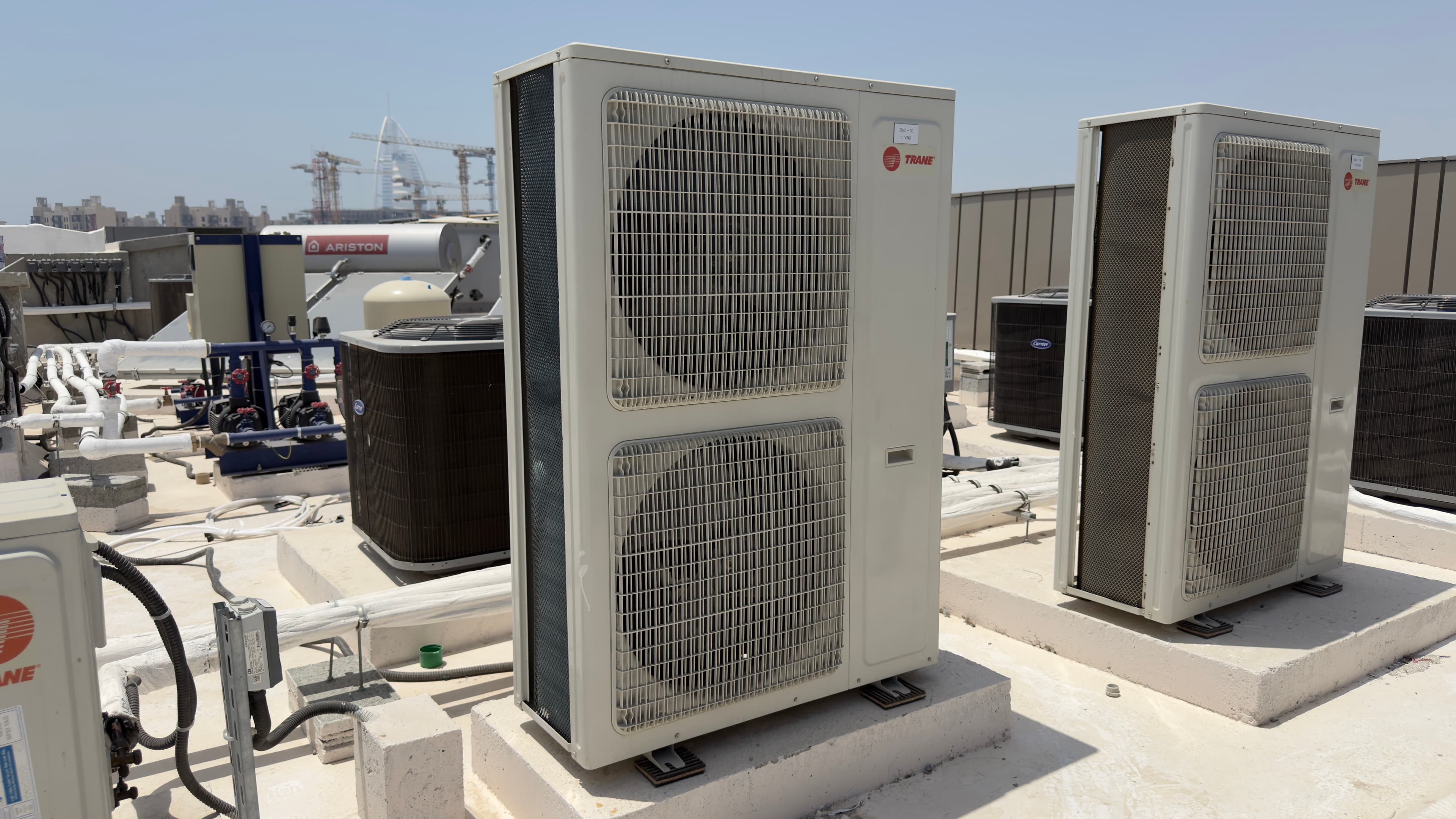
Every building owner in Dubai eventually faces the same uncomfortable moment: it's 47°C outside, the AC stops working, and the emergency service callout costs more than a year of regular maintenance would have. By then it's too late — the damage is done, the repair bill is large, and the building has been hot for hours while you wait for a technician who's already booked solid because everyone else's AC failed the same week.
This is the case for Annual Maintenance Contracts (AMCs) in Dubai. Not because contractors want recurring revenue (we do, but that's not the argument). Because the math genuinely works in your favor. Dubai's climate destroys HVAC equipment faster than almost anywhere else on earth — and equipment that fails unexpectedly in Dubai costs you in ways that go beyond the repair bill.
This article explains what proper HVAC maintenance actually looks like in the UAE, why preventive maintenance dramatically outperforms reactive servicing, and how to evaluate an AMC provider before signing.
What Dubai Actually Does to HVAC Equipment
Dubai's climate is one of the most punishing environments on earth for air conditioning equipment. Three factors combine in ways most equipment manufacturers don't fully account for:
1. Sustained extreme heat. Outdoor units in Dubai run at design conditions (45–50°C ambient) for 4+ months continuously. Most VRF and chiller equipment is designed for occasional peak conditions, not sustained operation at those peaks. Refrigerant pressures stay elevated, compressors work harder, and lubricant breakdown accelerates.
2. Fine sand and dust. The dust in Dubai is finer than typical desert dust because of the mix of natural sand and construction site debris. It penetrates everywhere — filters, coil fins, motor bearings, electrical contacts. A condenser coil that looks clean from a meter away can be 40% blocked at the fin level, silently destroying efficiency.
3. Humidity along the coast. Coastal Dubai areas — Marina, JBR, Business Bay, Palm Jumeirah — add salt-laden humidity to the heat-and-dust mix. Coil corrosion accelerates dramatically. Untreated condenser coils in these areas can lose 20–30% of their efficiency within just three years.
The combined result: HVAC equipment in Dubai requires roughly twice the maintenance attention of equipment installed in temperate climates to achieve comparable lifespan and efficiency.
The Real Cost of Skipped Maintenance
Most building owners think of maintenance as a cost. It's actually insurance against much larger costs. Here's what typically happens when HVAC equipment isn't maintained properly in Dubai:
Energy waste — the silent expense
A dirty condenser coil reduces system efficiency by 15–30%. On a typical villa running cooling 8 months of the year, that efficiency loss translates directly into thousands of dirhams in wasted electricity annually. The waste compounds — a system running at 70% efficiency this year usually runs at 60% next year if maintenance is skipped again. Over five years, the accumulated waste alone often exceeds what a quality maintenance contract would have cost over the entire period.
Compressor failure — the catastrophic expense
The compressor is the heart of any HVAC system. Replacement is one of the most expensive HVAC repairs you can encounter — covering not just the unit itself but specialist labor, refrigerant recovery, system flushing, and recommissioning. These failures are almost always preventable: dirty coils that cause overheating, refrigerant leaks left undetected for months, electrical issues that quarterly inspection would have caught early. By the time a compressor fails outright, the warning signs have usually been present for some time.
Refrigerant leaks — the hidden expense
A slow refrigerant leak on a VRF system can lose 10–15% of charge per year before performance noticeably degrades. By the time the system is obviously not cooling well, you've been paying inflated electricity bills for months, and the system may need a full pressure test, leak search, and recharge — work that's significantly more expensive than catching the same leak during routine maintenance.
Emergency callouts — the painful expense
Reactive service calls in Dubai's summer cost roughly 3–5 times the equivalent scheduled maintenance work. The reasons are simple: emergency demand massively outstrips supply during peak summer, qualified technicians are scarce, and the work has to happen immediately regardless of how difficult the conditions or how complex the repair. Owners who only call contractors when something breaks consistently pay more per year than owners with proper AMCs in place.
What a Proper AMC Should Include
Not all maintenance contracts are equal. In Dubai, many "AMC" contracts from less reputable providers amount to little more than quarterly filter changes — which leaves most of the failure modes above completely unaddressed. A proper AMC for the Dubai climate should include:
Quarterly visits at minimum
Twice a year is not enough for Dubai conditions. A reasonable schedule is March, June, September, December — covering pre-summer preparation, mid-summer performance check, post-summer recovery, and winter operation.
At every visit
- Indoor unit filter cleaning or replacement
- Indoor coil inspection and cleaning if needed
- Refrigerant pressure checks and recording
- Electrical connection inspection and tightening
- Drain line clearing and treatment
- Thermostat and controls function check
- Temperature delta and airflow verification at each unit
Annually (in addition to the above)
- Full coil cleaning — both outdoor and indoor — with proper cleaning chemicals
- Refrigerant charge verification with gauges
- Compressor electrical test (running amps, starting amps)
- Capacitor and contactor inspection
- Insulation integrity check on all refrigerant lines
- Outdoor unit anchor, vibration mounts, and structural inspection
- Full system performance report
For chiller systems, additionally
- Water chemistry testing and treatment
- Pump bearing inspection and lubrication
- Strainer cleaning
- Chiller tube cleaning (annual or as needed)
- BMS controls verification and calibration
Emergency response provision
Your AMC should include guaranteed response times for unscheduled failures — typically same-day for residential, within hours for commercial properties. Without a defined response time in the contract, "emergency response" means whatever the provider decides on the day.
Written documentation
Every visit should produce a written report showing what was checked, what was found, what was done, and what's flagged for future attention. If your current AMC provider can't show you written service reports, that's a major red flag. Verbal "everything looks fine" reports are how problems get missed for years.
How to Choose the Right AMC Provider
Whether you choose AGEC or another contractor, here's what to verify before signing any AMC in Dubai:
Engineering credentials. Is the provider a licensed HVAC contractor with qualified engineers on staff, or just a maintenance company subcontracting the technical work to whoever is cheapest? Ask to see the trade license and the engineers' qualifications.
Equipment expertise. Different brands have different service requirements. A provider who works on everything from window ACs to industrial chillers may not have deep expertise in your specific equipment. Ask specifically which manufacturers — Daikin, Trane, Mitsubishi Electric, Carrier, York — they're authorized or experienced to service.
Spare parts access. When something fails, can they get the right part quickly? Authorized service partnerships with major manufacturers matter for genuine parts, warranty preservation, and turnaround time on repairs.
Documentation practices. Ask to see sample service reports from existing clients (with sensitive details redacted). If they can't show you what their reporting actually looks like, that's a serious red flag.
Response time guarantees in writing. "We'll come quickly" is not a contract term. "Same-day response for emergencies, within 4 hours during business hours" is a contract term. Get specifics on paper.
Real client references. Ask for two or three current clients you can speak with directly. Reputable providers will offer this readily; less reputable ones will deflect.
Contract clarity. What's included, what isn't, what triggers additional charges. Vague contracts always favor the contractor in disputes — make sure you understand exactly what you're buying.
The Long-Term Picture
Dubai's climate is unforgiving. HVAC equipment that receives proper preventive maintenance routinely lasts 12–15 years for VRF systems and 20–25 years for quality chillers. Equipment that doesn't typically fails in half that time, with expensive failures along the way that could have been avoided.
The math is consistent: paying for proper maintenance is cheaper than paying for the consequences of skipped maintenance in this climate. The contractors and building owners who understand this — and budget for proper AMCs from day one — end up paying significantly less per year than those who try to save money by waiting for things to break.
If you currently don't have an AMC, or you have one but you're not seeing service reports and you're not confident in the work being done, it's worth getting a proper inspection and recommendation from a qualified contractor.
How AGEC Approaches AMC Contracts
AGEC provides AMC contracts across Dubai, Sharjah, and Abu Dhabi for both residential villas and commercial buildings — from single-family homes to large compounds and multi-tenant commercial properties.
Our approach focuses on three principles:
- Engineering-led maintenance — our maintenance teams are led by qualified HVAC engineers, not just technicians. Diagnosis comes before repair.
- Written documentation — every visit produces a written service report. You always know what was done, what was found, and what's coming up.
- Honest recommendations — we tell you when equipment needs replacing versus when it can be maintained further. We're not interested in selling new equipment that isn't needed.
To discuss AMC options for your property:
- Call us: +971 55 363 3139
- Request a quote: Get a free assessment
- Learn more: Our Maintenance & AMC services