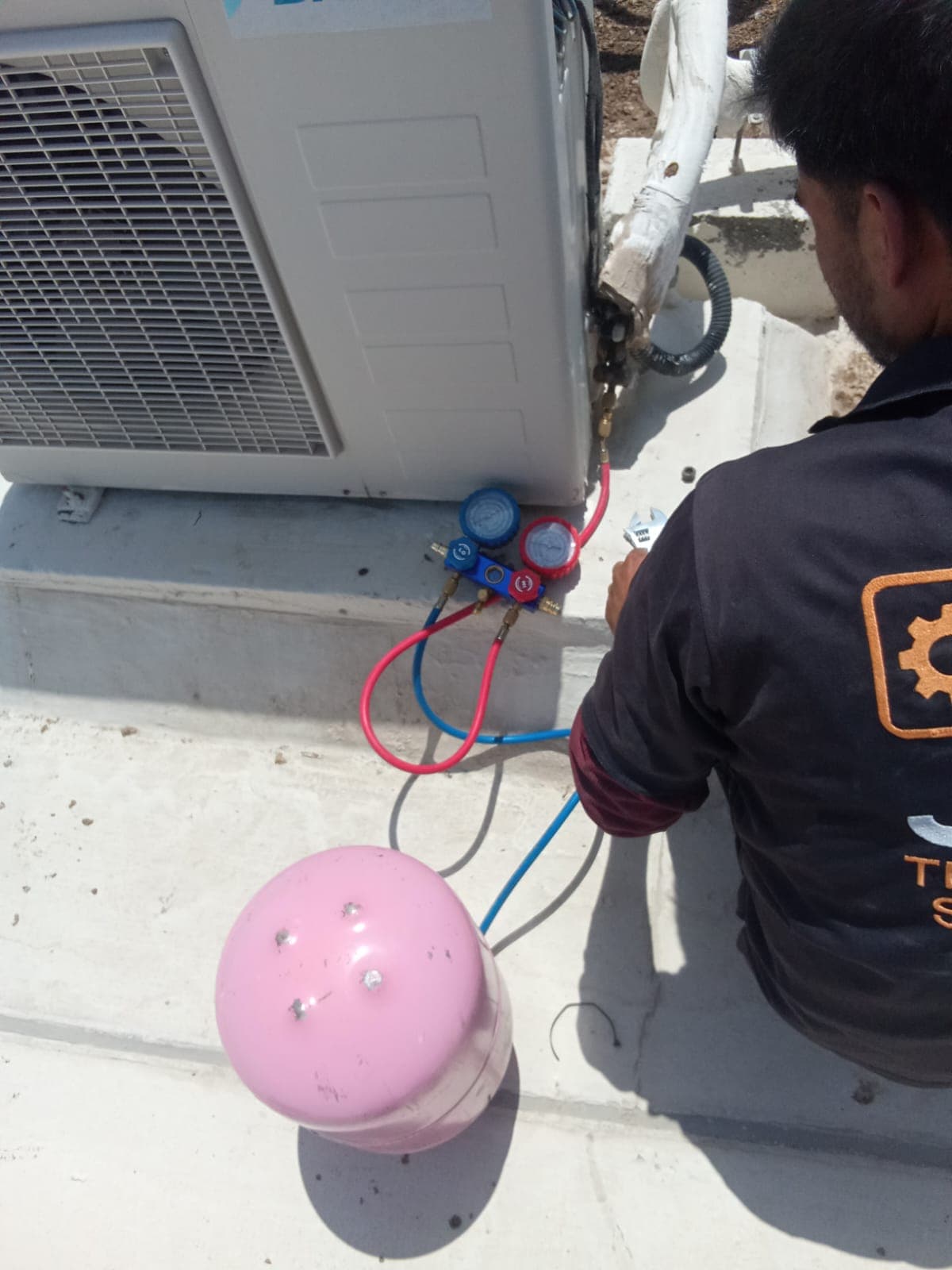
Every summer in Dubai follows the same script. The temperature crosses 45°C, the AC runs around the clock, and the DEWA bill arrives looking like a small rent payment. The instinct is to blame the tariff — but the tariff hasn't changed since 2022. What changed is how many kilowatt-hours your cooling system is burning to keep you comfortable, and how efficiently it's doing it.
We design, install, and maintain HVAC systems across Dubai, Sharjah, and Abu Dhabi, and we see the same bill-driving problems on site again and again. This isn't a "set it to 24°C" listicle. It's an engineer's breakdown of where your money actually goes, ranked by how much each problem really costs you — and what's worth doing about it.
First, understand what you're actually paying for
In a typical Dubai home, air conditioning is 60–70% of your summer electricity consumption. Everything else — lights, fridge, water heater, devices — fights over the remaining third. So when your bill spikes in July, it's almost always a cooling story.
How that cooling shows up on your bill depends on which system your building uses, and this is where most advice goes wrong because it treats both the same.
If your home runs on DEWA-metered AC (most villas and older buildings — split units, ducted splits, or a private VRF/chiller), your cooling shows up inside your normal DEWA electricity bill. DEWA uses a progressive slab tariff: the first 2,000 kWh a month cost 23 fils each, the next band costs 28 fils, then 32, and anything above 6,000 kWh costs 38 fils per unit — plus a fuel surcharge (around 6 fils/kWh) and 5% VAT on top. The catch is the slabs: a heavy-cooling villa doesn't just use more electricity in summer, it pushes that extra usage into the most expensive 38-fils band. The same air conditioner literally costs more to run per hour in August than it does in February, because of where your consumption lands on the slab.
If your building runs on district cooling (Empower, Emicool, or Tabreed — common in Marina, Downtown, Business Bay, JLT, JBR, Dubai Hills and most master-planned towers), you get a separate cooling bill on top of DEWA, and it works completely differently. There are two parts:
- A consumption charge — roughly AED 0.568 for every refrigeration-ton-hour of cooling you actually use. This is the part your behaviour controls.
- A capacity (demand) charge — around AED 750 per refrigeration ton per year for your apartment's installed cooling capacity, billed monthly whether you use the AC or not. A 6-RT apartment pays about AED 4,500 a year in capacity charges before cooling a single room.
That second charge is the single most misunderstood line in a Dubai cooling bill. You cannot lower it by setting your thermostat higher, switching the AC off when you travel, or cleaning a filter. It's fixed. So if you're on district cooling, half your "AC bill" is immune to every saving tip on the internet — and the half you can influence is the consumption charge. Knowing which system you have tells you which levers are even available to you.
With that settled, here's where the controllable money actually leaks.
The real reasons your bill is high — ranked by what they cost you
1. Your system is the wrong size for the space
This is the most expensive problem and the most invisible, because an oversized system still keeps you cool — it just does it wastefully. An air conditioner that's too large for the room cools the air fast, hits the setpoint, and shuts off before it has removed the humidity. The room feels cold and clammy, so you drop the setpoint further, and the unit short-cycles — switching on and off constantly. Every start-up is the least efficient moment in a compressor's cycle, so a short-cycling oversized unit can quietly burn 20–30% more energy than a correctly sized one while cooling the same room.
Undersizing is the opposite failure: the system runs flat-out for hours and never quite catches up, so it never gets a chance to switch off. Both problems trace back to the same root cause — equipment selected by rule of thumb ("one ton per X square feet") instead of a proper room-by-room heat load calculation that accounts for glazing, orientation, occupancy, and Dubai's actual ambient conditions. It's the most consequential decision in the whole system and the one most likely to be skipped.
2. Dirty coils, choked filters, and skipped maintenance
This is the cheapest problem to fix and the one we see most. A clogged filter or a dust-caked coil forces the system to work harder to move the same air and reject the same heat — and in Dubai's dust, coils foul fast. A neglected system can run 15–20% less efficiently for months before anyone notices, because it's still cooling, just expensively. The outdoor condenser is the worst offender: caked in fine desert dust, it can't dump heat properly, so the compressor runs longer and hotter for every degree of cooling.
The fix is unglamorous and it works: filters cleaned regularly through the cooling season, coils cleaned annually (more often here), and the condenser kept clear. This is exactly what an annual maintenance contract is for — and the maths is in your favour, because the efficiency you recover usually exceeds the cost of the service. [REAL CASE: insert one true example — e.g. "On a 4-bed villa in Mirdif, a coil clean and filter overhaul cut the August DEWA bill from AED X to AED Y."]
3. Old, non-inverter equipment
If your air conditioners are more than 10–12 years old, or they're fixed-speed (non-inverter) units, they're costing you money every hour they run. A fixed-speed compressor only knows two states — full blast or off — so it overshoots the setpoint, switches off, drifts warm, and slams back on. A modern inverter compressor instead modulates: it ramps down and runs gently at the partial load your home needs most of the time, which is where the savings live. Real-world replacements of old units with modern inverter systems commonly cut cooling energy by 30–50%. On a villa spending thousands a month in summer, that's a capital upgrade that can pay for itself in roughly two cooling seasons — and you get quieter, more even, less humid comfort as a bonus.
4. Duct leakage and weak insulation
In ducted and central systems, the cold air has to travel from the unit to your rooms through ductwork — and if that ductwork leaks or is poorly insulated, you are paying to cool ceiling voids, risers, and the gap above your gypsum. We've opened up ceilings to find duct joints blowing conditioned air into the void and insulation that was either missing or had degraded in the heat. Leakage of 15–25% is not unusual in poorly installed or aging systems, and you feel it as rooms that never quite cool while the unit runs forever. You can't see it from the thermostat, which is why it survives for years. Proper duct sealing and a system air-balance is the only way to find and fix it.
5. You're cooling rooms nobody's in
A lot of Dubai homes cool the whole property to the same temperature all day, including guest rooms, formal majlis, and spaces that sit empty 90% of the time. If your system has no zoning, every hour of cooling an unused wing is pure waste. A properly zoned VRF system or a well-set-up multi-zone control lets you cool the rooms in use and leave the rest idle — which matches how families actually live, with different rooms used at different times. Retrofitting zoning isn't free, but on a large villa it changes the running-cost equation permanently.
6. Your thermostat setting — the one lever fully in your hands
Every degree you drop the thermostat increases consumption by roughly 5%, and in Dubai's heat the effect compounds because the system has to fight a bigger gap against the outside temperature. Setting the AC to 19°C doesn't cool the room faster — the unit cools at the same rate either way — it just makes it run far longer to reach and hold a colder target. 24°C is the sweet spot most people find genuinely comfortable, and nudging up to 25–26°C overnight, when Dubai cools slightly and you're under a sheet, is free money. This is the only item on this list you can act on tonight at no cost.
7. The building itself — glazing, sun, and sealing
Some of your cooling load is the building, not the AC. Large unshaded west-facing glass pours heat in through the afternoon; gaps around doors, balcony thresholds, and service hatches let conditioned air leak out and hot air in. None of this is the air conditioner's fault — it's just being asked to fight a losing battle. Solar window film, shading or curtains on sun-exposed glass, and basic weather-stripping on leaky openings reduce the load the system has to meet in the first place, which is always cheaper than meeting a bigger load more efficiently.
What actually helps — ranked by return
Not every fix is worth the same. Here's the honest order, from "do it today" to "capital project":
Free, do it now
- Set the thermostat to 24°C; nudge to 25–26°C overnight and when you're out for the day (but don't switch a system fully off in peak heat — see the myths below).
- Close curtains on sun-facing windows during the afternoon.
- Keep external doors and balcony doors shut while cooling.
Low cost, high return
- Put the system on a proper maintenance contract: filters, coils, and condenser kept clean. This is the best dirham-for-dirham move for most homes — you're recovering 15–20% of efficiency you're already losing.
- Seal obvious air leaks around doors and windows.
- Add solar film or shading to your worst sun-exposed glass.
Capital, real payback
- Replace old fixed-speed units with inverter equipment if your kit is 10+ years old — typically a two-season payback in Dubai's climate.
- Seal and re-balance leaking ductwork.
- Add zoning if you're heating and cooling rooms nobody uses.
The pattern: spend nothing on behaviour first, then a little on maintenance and sealing, and only reach for capital upgrades once the cheap wins are banked.
The "savings tips" that barely move the needle
A few popular ideas are myths, and an engineer should say so plainly:
- "Blast it to 18°C to cool the room faster." It doesn't. The unit cools at a fixed rate; a colder setpoint just makes it run longer. You overshoot, get cold, and pay for it.
- "Switch the AC off completely whenever you leave." For a short trip in peak summer this can backfire — the building soaks up heat, and the system then works overtime to pull the whole structure back down, sometimes using more than if you'd left it at a high setpoint. Setting up to 27–28°C while you're out is usually better than off.
- "A fan instead of AC." A fan moves air; it doesn't remove heat. At 45°C it makes you marginally more comfortable but does nothing for the actual load. Useful alongside AC, not instead of it.
- "Plug-in energy-saver gadgets." The devices sold to "cut your AC bill" don't change the physics of how much heat your home gains. Skip them.
When a high bill is an engineering problem, not a habit
Some of these you can handle yourself. But a few signals mean the problem is in the equipment, not your behaviour, and it's worth getting an engineer in:
- Your summer bill is creeping up year over year with no change in how you live.
- Some rooms never reach temperature while the system runs constantly.
- The AC short-cycles — switching on and off every few minutes.
- The system is more than 10–12 years old.
- You're on district cooling and your consumption charge keeps rising even though your habits haven't.
Any of those usually means sizing, leakage, fouling, or aging equipment — and the fix pays for itself in running cost. If you want a straight answer, we'll look at the system, run the numbers, and tell you honestly whether it's a quick maintenance fix or a real upgrade. No sales pitch.
Frequently asked questions
What temperature should I set my AC to in Dubai to save money? 24°C is the sweet spot for most people — comfortable, and efficient enough that going lower mainly adds cost. Every degree below that raises consumption by roughly 5%, and the effect is larger in peak summer because the system fights a bigger gap against the outdoor heat. Nudge up to 25–26°C overnight and when you're out, but don't switch the system off entirely during a heatwave.
Does servicing my AC really lower my DEWA bill? Yes, and it's usually the best-value thing you can do. Dirty filters, fouled coils, and a dust-caked condenser can quietly cost you 15–20% in efficiency. In Dubai's dust that happens fast. Regular cleaning recovers that efficiency, and the saving typically outweighs the cost of the service over a summer.
Is district cooling (Empower) cheaper than a split or VRF system? Not necessarily — it's billed differently. District cooling splits your bill into a consumption charge for what you use and a fixed capacity charge (around AED 750 per refrigeration ton per year) that you pay whether you use the AC or not. So part of your cooling cost is fixed and can't be reduced by using less. A DEWA-metered split or VRF system has no fixed capacity charge, but you pay for the electricity directly on the slab tariff. Which works out cheaper depends on the property, the capacity allocated, and how you use it.
Will a new inverter AC actually pay for itself? Often, yes — if you're replacing fixed-speed units that are 10+ years old. Modern inverter systems commonly use 30–50% less energy for the same cooling, and on a high-summer-bill villa that can recover the upgrade cost in around two cooling seasons, with better comfort in the meantime. On newer or already-inverter equipment, the payback is much longer and maintenance is the smarter spend.
Why is my AC bill higher than my neighbour's identical apartment? Usually one of a few things: a lower thermostat setting, a poorly maintained or fouled unit, leaking or uninsulated ductwork, more sun exposure on your side of the building, or air leaks around doors and windows. Same floor plan doesn't mean same system condition or same habits — and small differences compound across a long Dubai summer.
Get a straight answer on your cooling bill
If your summer bills don't add up, we'll find out why — system check, heat load review where it's needed, and an honest call on whether it's a maintenance fix or an upgrade.
Request a quote or call +971 55 363 3139.
Related reading
- VRF vs Chiller Systems for Dubai Villas →
- AC Maintenance Contracts in Dubai: Why Reactive Maintenance Costs You More →
- HVAC Design & Consultancy →
- VRF / VRV Systems →
- Maintenance & AMC →
Altaher Ghabboun Engineering Contracting (AGEC) is a Dubai-based HVAC contractor specializing in design, installation, testing & commissioning, and maintenance of advanced air conditioning systems across the UAE.